What Happens With Cpa Course Review if Tax Changes
CPA Test Changes
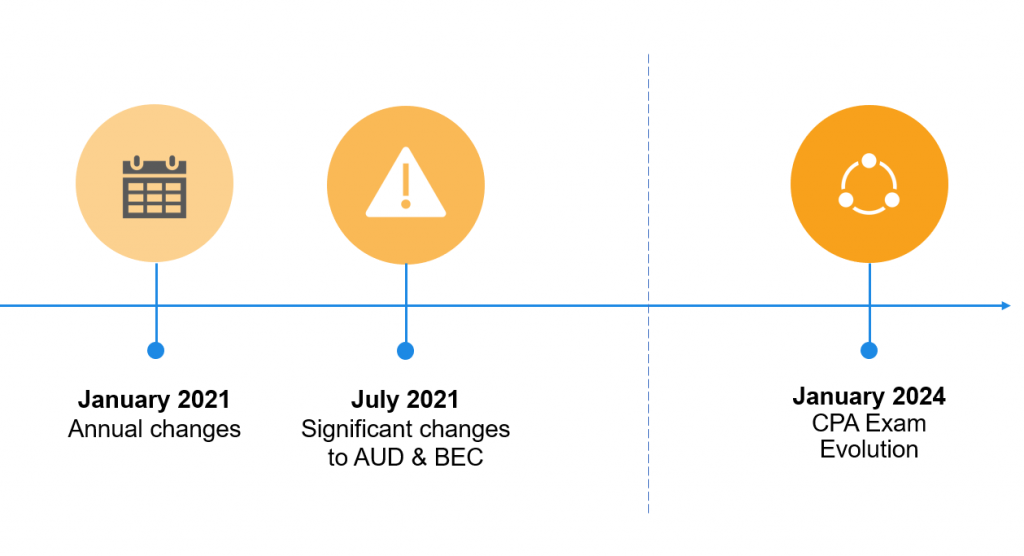
Each year, the AICPA approves various changes and updates to the CPA Exam, altering pre-existing sections, adding new topics and occasionally removing older ones. Read through the timeline below to learn virtually the upcoming CPA Test updates and subscribe to our newsletter to ensure you stay on tiptop of all of the latest changes to the CPA Exam.
Read the 2021 CPA Blueprints
The CPA Exam Blueprints are created by the American Institute of Certified Public Accountants (AICPA) to help CPA candidates know what skills and content topics volition be tested on the CPA Exam. Read the blueprints to know what you need to study!
Explore CPA Blueprints
2022 Changes | 2021 Changes | 2020 Changes | 2020 FAQ | 2019 Changes | 2019 FAQ
2022 CPA Examination Changes
The time is at present. Accept the first stride towards CPA Exam success!
Equally the accounting profession evolves, the CPA Test must do the same. The exam remains relevant as a measure of the cognition and skills newly licensed CPAs must have in order to exercise their profession and protect the public interest efficiently and effectively.
The UWorld Roger CPA Review course is rooted in the AICPA CPA Exam Blueprints, which is the framework for all the exam content. Our expert educational squad consists of practicing CPAs and accounting educators who are dedicated to ensuring students are thoroughly prepared for success on the most upwardly-to-date information.
We encourage candidates to try UWorld Roger CPA Review for 7-Days free. This includes access to the highest-quality practice CPA Test questions, the manufacture'due south most dynamic lectures, and our signature SmartPath Predictive Applied science. Plus, all class aspects are also available on our fully-featured mobile application.
Take your seven-Day Trial Now!
2022 CPA Exam Changes
There are no content updates for BEC or FAR for the 2022 CPA Examination. Changes to AUD and REG are outlined below.
AUD
The quick summary of changes to AUD for 2022 are:
- SASs No. 134 – 140 primarily deal with updates to the audit report for non-public companies and amendments to align other sections of the audit standards appropriately.
- SSARS No. 25, Materiality in a Review of Fiscal Statements and Adverse Conclusions, changes some of the rules applicable for reviews under the Statements on Standards for Accounting and Review Services.
Detailed View of Changes
SAS No. 134, Auditor Reporting and Amendments, Including Amendments Addressing Disclosures in the Inspect of Fiscal Statements, revises:
- The sample engagement letter
- The audit report for nonissuers. Various changes include:
- Reordering the report to exist similar to a PCAOB audit study, which starts with the auditor's opinion and is followed past the basis for opinion section
- Requiring a split section in the report when substantial doubt about the entity'southward power to continue equally a going concern exists
- Expanding the auditor'south responsibility section of the report
- Communicating key audit matters (KAMs) in the report (in a separate section) when the auditor is engaged to do so
SAS No. 135, Omnibus Statement on Auditing Standards, includes:
- Additional inquiries of the predecessor accountant regarding related party relationships/transactions and significant unusual transactions
- An additional inquiry of management and others regarding pregnant unusual transactions
- Additional examples of fraud chance factors
- Additional procedures to perform with respect to related parties
SAS No. 137, The Accountant'due south Responsibilities Relating to Other Information Included in Annual Reports, clarifies:
- The auditor's responsibilities with respect to other information included in an annual written report
- The definition of an almanac report for such purposes
SAS No. 138, Amendments to the Description of the Concept of Materiality, revises the definition of materiality.
SAS No. 139, Amendments to AU-C Sections 800, 805, and 810 to Comprise Auditor Reporting Changes From SAS No. 134 updates the reporting requirements with regard to special purpose frameworks to marshal with the new audit report structure.
SAS No. 140, Amendments to AU-C Sections 725, 730, 930, 935, and 940 to Incorporate Auditor Reporting Changes From SAS Nos. 134 and 137 revises the reporting requirements for the following types of engagements to align with the new audit report structure:
- GAAS integrated audits (ie, reporting on internal command in conjunction with a financial inspect)
- Reviews of interim fiscal data
- Government compliance audits
SAS No. 140, also requires separate sections in the written report for other data, supplemental information, and required supplemental information.
SAS No. 25, Materiality in a Review of Financial Statements and Adverse Conclusions:
- Requires the accountant to decide materiality for the financial statements as a whole, and pattern and perform review procedures to accost all material items
- Permits the expression of an adverse conclusion in a review engagement
- Requires the review report to include a statement that the accountant is independent
REG
The REG section of the CPA Exam volition see the post-obit temporary tax provisions expire with 2021, and prior rules will get testable again:
Consolidated Appropriations Human activity items
- 100% charitable contributions limit for individuals
- 25% of ATI charitable contribution limit for corporations
American Rescue Programme Deed (ARPA) items
- Increases in the Child Revenue enhancement Credit to $3,000 per kid under age xviii and $3,600 per child nether 6
- Increases in the Child and Dependent Care Credit to $iv,000 for one child and $8,000 for two or more than
- An increase in the employer dependent care exclusion to $10,500
Timeline of CPA Exam Changes
Latest CPA Examination Information
2021 CPA Exam Changes
The fourth dimension is now. Accept the first step towards CPA Test success!
Every bit the accounting profession evolves, the CPA Exam must do the same. The exam remains relevant as a mensurate of the knowledge and skills newly licensed CPAs must have in club to practise their profession and protect the public interest efficiently and finer.
The UWorld Roger CPA Review course is rooted in the AICPA CPA Exam Blueprints, which is the framework for all the examination content. Our adept educational squad consists of practicing CPAs and accounting educators who are defended to ensuring students are thoroughly prepared for success on the about upwardly-to-engagement information.
Nosotros encourage candidates to try UWorld Roger CPA Review for 7-Days free. This includes access to the highest-quality do CPA Test questions, the industry's most dynamic lectures, and our signature SmartPath Predictive Engineering. Plus, all class aspects are also available on our fully-featured mobile application.
Take your 7-Twenty-four hour period Trial Now!
October 2021 CPA Examination Changes
AUD
- Updated for SSAE No. 19, Agreed-Upon Procedures Engagements
- SSAE No. 19'southward most notable changes include:
- Eliminates the requirement to go an assertion from the responsible party
- Allows the practitioner to assist in developing the procedures every bit long as the engaging political party acknowledges the appropriateness of the procedures prior to the issuance of the report
- Allows the procedures to exist developed over the grade of the date
- Eliminates the requirement for intended users to take responsibleness for the sufficiency of the agreed-upon procedures
- Allows a general-use study to be issued
- SSAE No. 19'southward most notable changes include:
FAR
- Updated for ASU 2021-03, Intangibles—Goodwill and Other (Topic 350): Accounting Alternative for Evaluating Triggering Events
- ASU 2021-03 provides an boosted accounting alternative to help simplify and reduce the price of goodwill bookkeeping for private and not-for-profit entities. Under this new alternative, they can perform the required triggering event evaluation to test for impairment as of the stop of the reporting period, rather than having to monitor for triggering events and performing such evaluations throughout the reporting period.
REG
- Updated for American Rescue Programme Act (ARPA)
- ARPA has diverse small-scale changes that could be testable on the examination, such as:
- Increasing the Kid Tax Credit to $three,000 per child under age eighteen and $3,600 per child under 6*
- Increasing the Earned Income Credit limit for investment income to $10,000
- Increasing the Child and Dependent Care Credit to $4,000 for one kid and $8,000 for ii or more*
- Increasing the employer dependent care exclusion to $x,500*
- Expanding the exclusion for discharge of indebtedness to embrace qualified student loans
- ARPA has diverse small-scale changes that could be testable on the examination, such as:
*Note that some of these items are testable merely from 10/one/2021 to 12/31/2021.
July 2021
AUD & BEC
- Increased emphasis on:
- Understanding automated business processes and the related risks and controls,
- The importance of having a digital and data-driven mindset as well as the utilise of data analytics, and
- Arrangement and Arrangement Controls reports on controls over fiscal reporting at a service system (ie, SOC 1 reports).
Download our 2021 CPA Exam Changes Infographic.
Download our 2021 CPA Exam Changes Infographic. Larn more about what to await on the exam in 2021.
January 2021
There are simply pocket-size changes to the CPA Exam for January 2021. More robust changes were originally expected, only they have been delayed due to the pandemic.
REG
- Removal of almost CARES Human action changes
- Exam Topic: Individual and Corporate Revenue enhancement
FAR
- ASU 2018-fourteen—Bounty—Retirement Benefits—Divers Benefit Plans—General (Subtopic 715-20): Disclosure Framework—Changes to the Disclosure Requirements for Divers Benefit Plans
- ASU 2019-12, Income Taxes (Topic 740): Simplifying the Bookkeeping for Income Taxes
A Sampling of Changes Coming to the CPA Test
Topics to be Expanded on the Exam
Digital and Data-Driven Mindset and Other Technological Impacts
- AUD
- Business processes and internal controls
- Use of SOC 1 reports
- IT organization infrastructure
- Data flows
- Event of general and application controls on the completeness and reliability of data
- Use of automated tools and data analytics in the audit
- Skepticism and judgment in analyzing data
- Business processes and internal controls
- BEC
- Business concern processes and internal controls
- Agreement the importance of SOC i reports for outsourced Information technology functions
- Use of data and concern intelligence
- Data governance
- Data management
- Data relationships
- Working with data (extraction, transformation, and loading)
- Business concern processes and internal controls
Topics to be Removed from the Exam
- IFRS (FAR)
- Estate Tax (REG)
Changes in Content and Skill Weighting on July 1, 2021 Blueprints
- AUD
- Content Weighting
- Area II, Risk Cess and Planning, increased past 5%
- Area IV, Reporting, decreased by 5%
- Skills Weighting
- Shifting from Remembering & Understanding to Assay by five%
- Content Weighting
- BEC
- Content Weighting
- Area I, Corporate Governance, increased by 3%
- Expanse 2, Economics, decreased past 2%
- Area III, Financial Direction, decreased by 1%
- Skills Weighting
- No change
- Content Weighting
- No weighting changes for FAR and REG
2020 CPA Examination Changes
Equally of July 1, 2020, there were changes to both the REG (Regulation) and BEC (Business organization Environment and Concepts) sections of the CPA Exam. The July 1st updates contained the post-obit revisions:
Oct 2020
FAR
- CARES Act (Coronavirus Aid, Relief, and Economic Security)
- Test Topic: Bookkeeping for Income Taxes (Cyberspace Operating Losses)
- Modify in Definition of Accelerated Filer & Nonaccelerated Filer
- Test Topic: Reporting the Results of Operations (SEC Reporting Requirements)
REG
- CARES Human activity (currently only applicable for Q4 of 2020)
- Exam Topic: Individual and Corporate Taxation
- Modify in Definition of Accelerated Filer & Nonaccelerated Filer
- Test Topic: Federal Securities Regulations
FAR Changes on the 2020 CPA Exam
As of January ane, 2020, there have been major changes to the FAR examination, specifically surrounding Financial Instruments – Credit Losses. These changes are quite pervasive and complicated, as they apply to nearly financial assets and require the use of more judgment and various factors in developing expectations of credit losses.
Financial Instruments – Credit Losses (ASUs 2016-13, 2018-19, 2019-05) — The credit loss (ie, bad debt) changes are pervasive and complicated. These changes remove more bright-line rules that accountants are used to and require more judgment, and in some cases data analytics, to develop expectations for credit losses. Hither'south some of the basics:
- This represents a switch from anincurred credit loss model to a current expected credit loss (CECL) model to reflect economic downturns in the financial statements faster (ie, before recognition).
- The new model estimates expected credit losses over the lifetime of the asset for more credit risk transparency.
- Estimates tin be based on historical information, electric current weather or reasonable and supportable forecasts (eg, predictive data analytics).
- The new guidance applies to assets measured at amortized cost (eg, receivables and held-to-maturity debt securities) and available-for-sale (AFS) debt securities, equally well equally finance leases and off-residue-sheet credit exposures (eg, financial guarantees).
- When expected credit losses increase, an assart for credit losses (ie, a contra-account) is booked at the reporting date to adjust the value of the asset, and credit loss expense is recognized on the income argument.
- When expected credit losses subtract, the allowance for credit losses is decreased, and a credit loss expense is reversed on the income statement.
- Such assets are written off when they are entirely uncollectible.
Goodwill (ASU 2017-04)
The second pace in the goodwill impairment test (ie, calculating the implied fair value of goodwill) has been eliminated for simplification purposes.At present you basically but compare the off-white value of the reporting unit with its carrying value. If fair value is less than carrying value, so goodwill is impaired and a loss should be recognized.
- Aligns the accounting handling of implementation costs incurred in a deject computing arrangement that is treated as a service contract with the requirements to capitalize implementation costs incurred with respect to internal-use software.
- Expands the individual company accounting alternative for variable interest entities (VIEs) to provide an electionnot to apply the regular VIE GAAP guidance when sure criteria are met.
- Statement No. 87 provides a single model for charter accounting (ie, all leases are essentially finance leases, with limited exceptions).
- Statement No. 89 provides description on accounting for involvement cost incurred before the end of a construction period.
- Intangibles (ASU 2018-fifteen)
- Variable involvement entities (ASU 2018-17)
- GASB Updates
Further Breakdown of FAR 2020 CPA Exam Changes
Expected Credit Loss Model (ASC 326-twenty)
What assets will be affected past this change?
- Accounts receivable (A/R), financing receivables, finance leases, held-to-maturity (HTM) debt securities, bachelor-for-sale (AFS) debt securities, and other off-residuum canvas credit exposures (eg, financial guarantees).
How is each type of asset afflicted by the change?
- A/R, HTM debt securities, & finance leases:
- Guess losses over life of nugget with pools of assets that have similar gamble profile assumptions to capture gamble, fifty-fifty if the gamble is remote.
- Management should have a reasonable forecast of economic conditions and documentation to support this.
- For assets that are purchased having a meaning credit deterioration since issuance, an allowance needs to be recorded at acquisition.
- Significant new disclosures volition be required in statements.
- AFS debt securities:
- No longer consider the length of fourth dimension an instrument has been impaired in model.
- Record an allowance for credit losses instead of a reduction in amortized cost footing.
- Limit credit losses to excess of amortized cost over off-white value.
- Reduce allowance for credit risk improvements and reverse credit loss expense in the income statement.
How volition it affect the financial statements?
- Credit losses are recognized earlier than they would take been under current GAAP.
- Income becomes more volatile equally credit loss expense is recognized.
- More processes and controls demand to exist implemented by management to consistently pool assets and determine conditions that affect their model. Even if direction doesn't expect the allowance to change significantly, they need to have a repeatable and understandable process to how they came to that decision. Documentation in the notes to financials volition exist required.
- More than information will demand to be nerveless and included in the model to help management decide how to identify information that tin can be used in developing the reasonable and supportable forecast, whether internal or external, to estimate the expected credit losses.
What are the primal differences betwixt the old incurred loss model and the new expected credit loss model?
- Instead of reporting losses that have been incurred as of the residue sheet engagement, credit loss expense is now recognized for credit losses that are expected over the life of the asset. Since this recognition of losses volition now menstruum through the income statement, earnings will likely become more volatile.
- Pooling of assets that share a common gamble profile is required with the new model, whereas current GAAP permits only doesn't require this. Management discretion on what assets to pool together comes into play. This also means that where a single asset may not have had any expected credit losses, the puddle of like assets could.
- Economic atmospheric condition are considered in both current GAAP and the new model. The new model also includes management'due south expectations of time to come economic weather condition. This is another area where more judgment is required.
- The result of the new model should show upward on the balance canvass as what management thinks is the net corporeality that will be collected on the asset.
Implementation considerations for the expected credit loss model:
- Components of amortized toll include unpaid principal balance, accrued involvement, unamortized discounts / premiums, foreign exchange adjustments, and off-white value hedge accounting adjustments.
- Limited historical loss information may exist available for amortized cost other than unpaid main balance.
- Processes and controls will need to exist adult for gathering data for the components of amortized cost that haven't been historically captured.
- Pools of like avails based on gamble profile will need to be reviewed at each measurement date to ostend they still share risk attributes and belong to the aforementioned pool. This review and any changes will need to be documented.
- Losses need to exist reflected over the asset's contractual life.
- Included: expected prepayments and contractual extensions.
- Excluded: expected extensions, renewals and modifications.
- It may be hard to decide contractual life on assets that accept no stated maturity similar A/R and credit card receivables. Management will also need to determine if a loan refinance with the same lender would be considered a prepayment.
- Management judgment will be required to determine:
- The method that is most appropriate for determining credit losses. A diverseness of methods may be used, including the discounted cash flow method, loss-rate methods, curl-rate methods, probability-of-default method, and aging schedules.
- Designation of pools of assets with similar risk profiles. Take a chance of default is understandable but may also include specific asset risks for the company or the visitor's ambition for more or less risk based on its individual tolerance.
- Key economical variables used in model.
- Selection of reasonable and supportable forecast flow.
- Conclusion of how to select the estimate used—is it a single about likely outcome or a weighted average outcome based on probability?
- Support adjustments to historical loss information and reversion methodology to the historical loss model past the reasonable and supportable forecast period of the expected loss model.
- Is it worth managing all this information or can an external source of data be used?
Reference commodity:https://www.ey.com/publication/vwluassetsdld/technicalline_04486-181us_creditlosses_4october2018/$file/technicalline_04486-181us_creditlosses_4october2018.pdf?OpenElement
Goodwill (ASU 2017-04)
- The only pace in determining goodwill impairment will exist the electric current ist pace of the harm determination: comparison the fair value of a reporting unit of measurement with the carrying amount. If the cost is greater than fair value, the goodwill damage charge equals the departure up to the amount of goodwill allocated.
- The primary goal of the standard is simplification and providing cost savings to all entities.
- Any loss recognized should not exceed the total corporeality of goodwill allocated to that reporting unit.
- Impairment losses on goodwill tin can't be reversed once recognized.
Reference article: https://www.bdo.com/insights/assurance/fasb/fasb-flash-written report-february-2017-(1)
Intangibles (ASU 2018-fifteen)
The indicate of this guidance is to reduce diversity in practice for the costs of implementing cloud calculating arrangements or hosting arrangements that are service contracts. Entities that historically capitalized implementation costs for internal use software projects should apply their existing policies and procedures to implementation costs incurred in hosting arrangements that are service contracts.
Customers should apply ASC 350-40 to determine whether to capitalize implementation costs of the cloud calculating organization or expense them as incurred.
- Only qualifying costs incurred during application development phase tin exist capitalized. Examples: costs of integrating the hosting arrangement with software on site, coding, configuring, customization, compensation and benefits for employees for time spent on application development activities, and interest costs incurred while implementing the hosting system.
- Other costs are required to exist expensed like costs of project planning, preparation, maintenance later implementation, and information conversion. Overhead costs (general and administrative) and preparation costs non related to software evolution or implementing the hosting arrangement tin can't be capitalized.
- For multiple chemical element arrangements like training, hosting, maintenance, data conversion, etc. bundled together, companies need to classify the costs to each chemical element on the relative standalone price for each role of the contract.
- Companies implementing hosting arrangements with multiple modules should accrue costs and amortization records at the module level and so that they can begin amortization at the appropriate time for that module. Documentation of modules, costs, obsolesce, and harm or abandonment are required.
Reference articlehttps://www.ey.com/publication/vwluassetsdld/technicalline_04271-181us_cloudcomputing_6september2018/$file/technicalline_04271-181us_cloudcomputing_6september2018.pdf?OpenElement
Variable interest entities (ASU 2018-17)
This standard applies to all entities except for public entities, non-for-profit entities, and employee benefit plans qualifying common control arrangements. It creates an alternative accounting policy election to not employ VIE guidance to legal entities under common control. All the following criteria must be met for this election:
- Reporting entity and legal entity are under mutual control.
- Reporting entity and legal entity are not under common command of a public entity.
- Legal entity under mutual control is non a public entity.
- Reporting entity doesn't have a direct or indirect decision-making financial involvement in the legal entity.
Additional disclosures are required related to the reporting entity's involvement and exposure to entities with this election. While it doesn't require consolidation, a combined financial argument presentation is still an pick to testify combined results for entities nether common control. Early adoption is immune, and entities are required to apply the amendments retrospectively.
Reference article: https://www.cohencpa.com/insights/articles/asu-2018-17-a-private-visitor-accounting
GASB Statement No. 87
The rule modify will make GASB charter accounting similar to FASB lease accounting where substantially all leases will exist required to be reported on the residual sheet. Distinctions between operating and finance leases, withal, are eliminated.
For Lessees:
- Lease liabilities will be considered long-term debt.
- Charter payments will be financing outflows on the cash menses statement.
- For operating-type leases, hire expense will no longer be reported in the activity statement. Instead, involvement expense on the liability and amortization expense related to the asset will exist reported.
For Lessors:
- Lessor accounting volition mirror lessee accounting—this is different from FASB and IASB.
- Lessor volition recognize a lease receivable and a corresponding deferred inflow while yet reporting the asset underlying the lease.
- Involvement income from the receivable will be recognized using the effective interest method.
- Lease revenue will be recognized through amortizing the deferred arrival over the charter term.
- New rules exclude leases associated with investment avails carried at fair value similar investment rental property. This accounting doesn't change from current treatment.
GASB vs. FASB Differences
- Right-of-apply assets may amortize more quickly than liabilities in GASB, which will negatively impact net position. FASB's handling has the asset and liability at roughly the same amount.
- FASB reports lease liabilities as long-term operating payables. GASB has them equally long-term debt. This could impact compliance with debt covenants.
- FASB reports direct-line rent expense, and GASB reports interest expense on the liability and acquittal expense on the asset. This speeds up expense recognition.
- Argument of cash flows: GASB – capital financing outflows / FASB – operating outflows.
Reference article: https://www.pwc.com/united states/en/cfodirect/publications/in-cursory/gasb-lease-bookkeeping-rules.html
GASB Statement No. 89
This statement requires land and local government agencies, including public housing authorities, to expense interest during the construction period instead of capitalizing the interest and including it in the asset'southward value. The change was made to simplify reporting and show the true price of borrowing. The benefit of expensing involvement has an immediate impact on the income argument instead of amortizing over several years.
Reference article: https://www.bdo.com/insights/business organization-financial-advisory/pha-finance/%E2%80%8Bgasb-statement-89-accounting-for-interest-costs
2021 CPA Exam Changes Q & A
If you purchase a Roger CPA Exam review grade at present, y'all volition have access to a fully upgraded course platform in one case the 2021 CPA Exam changes become into result in Jan 2021. All Roger CPA Review students volition receive automated updates to their online course materials for the duration of their grade.
Exam content tests the skills that newly licensed CPAs must know to continue to protect the public interest, including:
- Critical thinking, trouble solving, analytical ability, and professional skepticism
- Effective advice skills
- Well-developed research skills
- A strong understanding of the concern environment and processes
- Ethics and professional responsibilities
2019 CPA Exam Changes
Play Video
Video Transcript
Hello and welcome. My name is Roger Philipp of Roger CPA Review. Today I wanna talk well-nigh the meridian two changes to the CPA Examination in 2019.
We've been working hard to ensure that our 2019 course materials reverberate the updates to the CPA Exam provided to us by the AICPA. While at that place are not structural changes on the exam, there are major content changes happening on the FAR and REG exams that are going into effect January 1st, 2019.
In Financial, Accounting, and Reporting, or in FAR, the big expanse that changed is leases. In 2016, the FASB issued ASC 842, which updated the accounting treatment of the leases. The goal was to provide more transparency and comparability amongst companies regarding charter assets and liabilities. To aid ensure the transition, the Board allowed entities to adopt both the new lease standard and information technology wasn't gonna hit the exam or isn't until January 2019, which is at present quickly approaching. Some of the changes include residual sheet recognition. Operating leases lasting over 12 months at present must be reported on the residuum sheet. So earlier we had what nosotros chosen an off-balance sheet gamble, at present they have to be listed in the residue sheet. The new standard creates transparency for investors regarding a company'southward fiscal leverage and earnings. With financial statement disclosures, ASC 842 has much more stringent disclosure requirements for both quantitative and qualitative financial statement disclosures. The increased requirements may crave companies to improve or implement new systems, procedures, and controls to provide the required disclosure. Charter qualification, long-term leases are at present reported on the residual sheet. Short-term leases of 12 months or less are even so allowed to exist excluded from the balance sheet, but y'all could include them if you so desire. The new standard dictates that if the lessee does non have the right to control the use of the asset, and then the transaction may non qualify as a charter. So that deals with control, so you've got to have the control. With lease payments there is a new revised definition of indirect costs resulting in fewer allowed capitalized costs. Executory costs, like property taxes, insurance, will now be included in lease payments. Regarding a sale leaseback transaction, so you sell it and so you immediately lease it back, to qualify as a sale, the transfer of the asset must adhere to the revenue recognition requirements in ASC 606, which deals with acquirement from customers with contracts. When the transaction does not authorize as a sale, it is classified as a financing transaction, so kinda like you borrow the money in more of what nosotros call a notation payable.
And then what does all of this mean for yous? Well, since several bright-line tests take been removed, the update likewise requires that more judgment be practical. Because we used to have these four criteria for a capital letter lease, at present we call it a finance charter. Now there's five criteria. Things like specialized nature, a buy option, title transfer, but here is an area where it kinda got a niggling gray. The term, it says it has to be a major part of the lease, used to say 75%. Payment, essentially all, which used to be 90% of the fair marketplace value. So that's where the bright-line tests kinda come in. And then what you're gonna see is you're gonna need more of what we phone call brain power when addressing these questions on the CPA Examination once these changes go into effect on January 1st, 2019.
Now let's talk a niggling bit about regulation changes, particularly in the surface area of taxation. This is probably the biggest change that anybody is talking about to the CPA Exam, especially in Regulation. And this is due to what we call the TCJA, which is the Revenue enhancement Cut Job Acts of 2017. This significantly changed and updated the taxation code, which impacts all the sections of tax, which accounts for almost every bit upwards to 85% of the Regulation exam. This is the department we highly recommend that you take this year in 2018, as it volition require you to relearn all that great stuff that you studied in schoolhouse about taxes, whether it was in university or whether yous've been working in the existent world, it'll all change.
Here are some, just a few of the examples of the changes.
- There's an increase in the Section 179 deduction. Then nosotros talk about deductions for depreciation and bonus depreciation. Used to be nigh half a million, now it went up to a million, starts to phase out at $two.5 million.
- Increased standard deduction, merely the elimination of the personal exemption. So no more than personal exemption, dependency exemptions, but your standard deduction is $12,000. Married, filing joint, double or $24,000. Might exist a adept reason to get married.
- New limitations on belongings and country taxes, equally well as local taxes and also mortgage interest. So your property and state taxation and all those are limited to $10,000 max. Your mortgage interest used to be a million one. They dropped information technology down to $750,000.
- There'southward as well a new deduction of up to 20% for owners of sure pass-through entities, like Due south-corps, partnerships, and and so on. Information technology'south chosen a QBI deduction, or a Qualified Business concern Income Deduction, which is really nice.
- If we increase the charitable contribution, so if you donate cash, you could instead of 50% of AGI, they increased information technology to threescore% of AGI.
- Entertainment expenses are now disallowed. So we used to do meals and entertainment. Now it's just meals, no more entertainment.
- The new corporate tax rate, a flat revenue enhancement rate, it went from 35% down to 21%, which is helpful. And that whole purpose was to bring corporations back in the United States. Increased gross receipts test, which allows more entities at present to use the greenbacks basis or cash method of accounting. Used to be at $10 million, they increased to $25 1000000.
And so in conclusion, you lot can encounter that the CPA Exam content updates to these two areas volition be significant. If you need help working these exams into your busy schedule, our new SmartPath Predictive Technology is the most effective way to maximize your report time. Well, it's a information-driven platform that tells yous exactly where and how to focus your efforts. It takes the guesswork out of CPA Exam preparation. Information technology'southward helping candidates pass the test faster than ever earlier. They're more than effective, they're more efficient. No matter when you lot determine to take the test, we have your back and we'll guide you on the SmartPath to CPA Test success.
Thank you and expert luck in your studies.
Learn about the tiptop 2 changes to the 2019 CPA Examination and how our patent pending SmartPath Predictive Applied science volition assist you pass faster than ever earlier. We understand the importance of providing students with everything they need to successfully prepare for and take the CPA Examination. Our good team of CPAs worked hard to ensure our 2019 course materials addressed the July 2019 CPA Exam changes that were eligible for testing on July i, 2019. Our course was updated by June 11, 2019 to adjust the July 1st revisions. The updates in our course software not only prepared students for the changes, but also gave them the confidence and resources they needed on Exam day. Run across revisions below for each 2019 CPA Exam section.
2019 CPA Exam Changes by Role
Auditing and Testament (AUD)
Blueprints: The 2019 AUD Blueprints do non include whatever boosted or eliminated content areas. Yet, there have been revisions to add more detail on professional skepticism and Inspect Data Analytics (ADAs). Notation that these updates do non change the nature or scope of content eligible for testing.
- Added references to professional person skepticism in the section introduction:
- Professional person skepticism reflects an iterative process that includes a questioning mind and a critical cess of inspect bear witness. It is essential to the practice of public accounting and the work of newly licensed CPAs.
- Added a Topic in Expanse I, Group B titled "Professional skepticism and professional person judgment" with the following remembering and understanding task statements:
- Understand the concepts of professional skepticism and professional person judgment.
- Empathise personal bias and other impediments to acting with professional skepticism, such as threats, incentives and judgment-making shortcuts.
- Added an assay representative task argument in Expanse III, Group A – Performing Further Procedures and Obtaining Evidence - Agreement sufficient appropriate evidence, every bit follows:
- Investigate show that either contradicts or corroborates management explanations, expectations and other hypotheses throughout an audit or non-audit appointment.
- Revised the analysis representative task statement in Expanse III, Grouping C, Topic 3 – Performing Further Procedures and Obtaining Testify – Performing specific procedures to obtain evidence - Inquiry of direction and others, as follows:
- Clarify responses obtained during structured or informal interviews with management and others, including those in non-fiscal roles, and inquire relevant and effective follow-up questions to sympathize their perspectives and motivations in an audit or non-audit appointment.
- Added an analysis representative task statement in Area 3, Grouping C, Topic 6 – Performing Farther Procedures and Obtaining Show – Performing specific procedures to obtain show - All other procedures, as follows:
- Modify planned procedures based upon new information, such as inconsistent explanations, new prove and environmental cues, to achieve audit objectives in an audit of an issuer or a nonissuer.
- Revised the 3rd bullet nether the Area II description:
- Assessing Risks and Planning Farther Procedures — Identifying and assessing risks of misstatement due to mistake or fraud and developing appropriate date procedures, including understanding and calculating materiality and because specific engagement risks, too as incorporating concepts such equally inspect information analytics, group audits, using the work of the internal audit part and the piece of work of specialists.
- Revised the 1st sentence in the description of Area Iii:
- Area 3 of the AUD section pattern covers performing date procedures and concluding on the sufficiency and appropriateness of evidence obtained, including performing specific types of procedures (e.g., analytical procedures, analytical procedures using inspect data analytics, observation and inspection, recalculation and reperformance); testing the operating effectiveness of internal controls; performing tests of compliance and agreed-upon procedures; understanding and responding to specific matters that crave special consideration (e.g., accounting estimates, including fair value estimates); evaluating and responding to misstatements due to mistake or fraud and to internal control deficiencies; obtaining management representations; and performing procedures to identify and answer to subsequent events and later discovered facts.
- Revised the application representative task statements in Area 2, C, four:
- Identify and document an entity's cardinal It general and awarding controls, their impact on the inspect of an entity'south fiscal statements, including an audit of an entity'southward internal controls, and consider the effect of these controls and manual controls on the abyss and reliability of an entity's data.
- Perform and document tests of an entity's key It general and application controls, their affect on the audit of an entity'due south financial statements, including an audit of an entity's internal controls, and consider the event of these controls and manual controls on the completeness and reliability of an entity'south data.
- Added an analysis representative task statement in Area II, Eastward, iii:
- Assess risks of material misstatement using audit information analytic outputs (east.g., reports and visualizations) to determine relationships among variables and interpret results to provide a basis for developing planned audit procedures.
- Added an assay representative chore statement in Expanse Three, C, ane:
- Perform analytical procedures using outputs from audit information analytic techniques to determine relationships among variables and interpret results in an inspect or non-audit date.
- Added 2 analysis representative task statements in Area Iii, C, half dozen:
- Determine the attributes, structure and sources of data needed to consummate audit data analytic procedures.
- Utilise audit data analytic outputs to determine relationships amongst variables and interpret results to run across objectives of planned procedures in an audit or non-audit date.
Content: The AUD section of the Exam will see some slight adjustments in content for 2019, including:
- PCAOB release 2017-001, The Accountant's Report on an Audit of Fiscal Statements when the Accountant Expresses an Unqualified Opinion and Related Amendments to PCAOB Standards—Eligible for testing Q3 2018 (except for critical audit matters, which is eligible for testing in Q3 of 2019).
- SSARS No. 24, Motorcoach Statement on Standards for Accounting and Review Services —2018—Eligible for testing in Q3 2019.
- Government Auditing Standards—2018 Revision (Yellow Book)—Updates related to performance audits are eligible for testing in Q3 of 2019 (Updates related to financial audits, attestation engagements, and reviews of financial statements are eligible for testing in Q3 of 2020).
Business concern Environment and Concepts (BEC)
Blueprints: In that location have been revisions to the July 2019 BEC Blueprints to add together clarification and reorganize the cloth. However, the revisions do not significantly change the content eligible for testing. More than specifically, these changes:
- Analyze the Section introduction by:
- Replacing the description of Area I with the following:
- Area I of the BEC department design covers several topics related to Corporate Governance, including the following:
- Knowledge and use of internal control frameworks
- Cognition and use of enterprise take a chance management frameworks
- Identifying key corporate governance provisions of regulatory frameworks and laws such as the Sarbanes-Oxley Act of 2002
- Area I of the BEC department design covers several topics related to Corporate Governance, including the following:
- Replacing the description of Expanse Four with the post-obit:
- Expanse IV of the BEC section blueprint covers several topics related to Information Technology (IT), including the following:
- Understanding the part of It and systems, including the use of data in supporting business decisions.
- Identifying IT-related risks associated with an entity'south data systems and processes, such as processing integrity, protection of data and organization availability, including those risks introduced past the relationships with tertiary-parties.
- Identifying application and IT general control activities, whether manual, It dependent or automated, that are responsive to Information technology-related risks, such as access and authorization controls, arrangement implementation testing and incident response plans.
- Adding a reference:
- COSO-issued application cloth, thought papers and guides related to the above frameworks
- Expanse IV of the BEC section blueprint covers several topics related to Information Technology (IT), including the following:
- Replacing the description of Area I with the following:
- Reorganize Area IV, It, to clarify the nature and scope of content. The following representative tasks have been revised every bit follows:
- Area Four, A, 1 – Understanding of it (IT) – Organization and governance: Identify the function of information systems (e.g., enterprise and application systems) in key business organization processes (e.g., sales, cash collections, purchasing, disbursements, homo resources, payroll, production, treasury, stock-still assets, general ledger and reporting).
- Area IV, A, 3 – Understanding of information technology (Information technology) – Data:
- Understand fundamental characteristics of a relational database (east.thou., data dictionary, data types, tables, records, fields, relationships, keys, views, queries and reports).
- Recognize the role of big data in supporting business organization decisions.
- Surface area IV, A, 3 – Agreement of information applied science (IT) – Data: Use business intelligence (including data analytics and statistics) to back up business organisation decisions.
- Area IV, B, 1 – Risks associated with IT - Risk assessment: Identify Information technology-related risks and describe mitigation strategies given chance severity, probability and costs.
- Surface area Iv, B, 2 – Risks associated with Information technology - Organization development and maintenance: Make up one's mind the fundamental bug and risks associated with selecting, developing and implementing new data systems or maintaining existing information systems.
- Surface area 4, Group B, Topic 3 – Risks associated with It - Processing integrity: Decide the risks associated with ensuring the completeness, accuracy and connected processing integrity in input, storage, processing and output processes.
- Area IV, Grouping B, Topic 3 – Risks associated with Information technology - Processing integrity: Make up one's mind the risks associated with ensuring the completeness, accuracy and connected processing integrity in input, storage, processing and output processes.
- Area IV, B, iv – Risks associated with Information technology - Security, availability, confidentiality and privacy:
- Place the risks (e.g., cybersecurity and internal) associated with protecting sensitive and disquisitional data (due east.g., proprietary and personal information) inside information systems (including processing, storing and transmitting information internally and with external parties).
- Perform threat identification to identify risks related to data confidentiality.
- Area IV, B, 4 – Risks associated with IT - Security, availability, confidentiality and privacy: Perform threat identification to place risks related to system availability.
- Expanse IV, C, 1 – Controls that answer to risks associated with IT – Application controls: Decide the role and appropriateness of input, storage, processing, and output application controls (e.g., authorizations, approvals, tolerance levels, input edits and configurations) to support completeness, accuracy and continued processing integrity.
- Area Four, C, 2 – Controls that respond to risks associated with IT - Full general IT controls:
- Understand the controls and testing strategies used in selecting, developing and implementing new data systems.
- Identify effective Information technology command activities, including manual, Information technology dependent and automated controls, as well as preventive, detective and cosmetic controls.
- Expanse Four, C, three – Controls that answer to risks associated with IT - Logical and physical controls: Place logical and physical access controls (e.m., roles and rights and segregation of duties).
- Expanse Four, C, iii – Controls that respond to risks associated with IT - Logical and physical controls:
- Place the controls associated with protecting sensitive and disquisitional information (e.g., proprietary and personal) inside information systems.
- Determine responses to information system confidentiality risks (e.g., incident response plan).
- Area IV, C, 4 – Controls that answer to risks associated with Information technology - Continuity and recovery plans: Decide responses to organisation availability risks (eastward.g., information backup and recovery procedures and alternate processing facilities).
Content: There are no new content updates to BEC for 2019.
Financial Accounting and Reporting (FAR)
Blueprints: The FAR Blueprints have ane change in response to ASU 2016-14: Presentation of Financial Statements of Non-for-Turn a profit Entities (eligible for testing on January 1, 2019).
- Added a Topic titled "Notes to the fiscal statements" to Surface area I, C – Conceptual Framework, Standard-Setting and Financial Reporting - General-purpose financial statements: nongovernmental, not-for-profit entities with the following application chore statement:
- Suit the notes to the fiscal statements to correct identified errors and omissions.
Content: The about prominent change to the FAR Exam in 2019 is to the highly tested topic, Leases (ASU 2016-02, 2018-01, 2018-ten, 2018-eleven, 2018-20 and IFRS xvi). Yous've probably already heard almost it since the standards have been out since 2016, just just in case y'all oasis't, you might similar to know that "off-residue sheet financing" has been eliminated. Operating leases must now exist recognized by the lessee on the remainder sheet (except for short-term leases of 12 months or less). Previously, simply capital leases (now called "finance leases") were recognized on the balance sail. It's of import to note that IFRS 16 is slightly dissimilar in that it essentially considers all leases to be finance leases unless they are worth $v,000 or less.
You might also note that several brilliant-line tests have been removed and more judgment is now required, making the standard slightly more than difficult to employ. For example, there is no more "deal purchase option" for purposes of determining whether a lease is a finance lease. A purchase selection must now be "reasonably certain to be exercised"; i.eastward., information technology no longer actually matters whether it is a bargain or not.
In addition to this major charter accounting makeover, there are a few other minor modifications that are testable in 2019:
- ASU 2017-06: Plan Accounting: Defined Benefit Pension Plans (Topic 960), Defined Contribution Alimony Plans (Topic 962), Health and Welfare Benefit Plans (Topic 965): Employee Benefit Programme Master Trust Reporting
- ASU 2017-08: Receivables—Nonrefundable Fees and Other Costs (Subtopic 310-20), Premium Acquittal on Purchased Callable Debt Securities
- ASU 2017-eleven: Earnings Per Share (Topic 260), Distinguishing Liabilities from Equity (Topic 480), Derivatives and Hedging (Topic 815): I–Accounting for Certain Financial Instruments with Down Round Features, II–Replacement of the Indefinite Deferral for Mandatorily Redeemable Financial Instruments of Certain Nonpublic Entities and Sure Mandatorily Redeemable Noncontrolling Interests with a Scope Exception
- ASU 2017-12: Derivatives and Hedging (Topic 815): Targeted Improvements to Accounting for Hedging Activities
- ASU 2018-02: Income Statement—Reporting Comprehensive Income (Topic 220): Reclassification of Certain Tax Effects from Accumulated Other Comprehensive Income
- ASU 2018-03: Technical Corrections and Improvements to Financial Instruments—Overall (Subtopic 825-10): Recognition and Measurement of Financial Avails and Financial Liabilities
- ASU 2018-04: Investments—Debt Securities (Topic 320) and Regulated Operations (Topic 980): Amendments to SEC Paragraphs Pursuant to SEC Staff Accounting Bulletin No. 117 and SEC Release No. 33-9273
- ASU 2018-05: Income Taxes (Topic 740): Amendments to SEC Paragraphs Pursuant to SEC Staff Bookkeeping Message No. 118
- ASU 2018-07: Bounty—Stock Bounty (Topic 718): Improvements to Nonemployee Share-Based Payment Bookkeeping
- ASU 2018-08: Not-For-Profit Entities (Topic 958): Clarifying the Scope and the Accounting Guidance for Contributions Received and Contributions Made
- ASU 2018-09: Codification Improvements—Eligible for testing in Q2 of 2019
GASB Updates:
- Statement No. 84 – Fiduciary Activities
- Statement No. 88 – Certain Disclosures Related to Debt, including Straight Borrowings and Directly Placements
Regulation (REG)
Blueprints: The revisions made to the REG Design in January of 2019 were to adapt taxation reform. The mid-year Blueprint changes merely provide description and do non change the nature and scope of content eligible for testing.
- Revised existing analysis task statement in Area Three, Group B - Federal Taxation of Property Transactions - Price recovery (depreciation, depletion and amortization) to read as follows:
- Compare the revenue enhancement benefits of the different expensing options for tax depreciation for federal income tax purposes.
- Added an application representative chore statement in Surface area IV, Group C – Federal Taxation of Individuals (including tax preparation and planning strategies) - Adjustments and deductions to arrive at adapted gross income and taxable income, as follows:
- Calculate the qualifying business organization income (QBI) deduction for federal income tax purposes.
- Removed reference to personal exemptions from Group F of Area IV, Federal Taxation of Individuals (including tax preparation and planning strategies) - Filing status and exemptions, deleted ii chore statements on personal exemptions, and added the post-obit remembering and understanding task statement:
- Recall relationships meeting the definition of dependent for purposes of determining taxpayer filing status.
- Removed references to alternative minimum tax for C Corporations and removed task statements focused solely on testing culling minimum taxation for C Corporations in Area 5, Grouping C, Topic 1 – Federal Taxation of Entities (including tax preparation and planning strategies) - C Corporations - Computations of taxable income, revising existing task statements as follows:
- Calculate the credits allowable as a reduction of tax for a C corporation.
- Analyze the bear on of net operating and/or capital losses during taxation planning for a C corporation.
- Added remembering and agreement representative task statements in Expanse 5, Group C, Topic 5 – Federal Tax of Entities (including tax preparation and planning strategies) - C Corporations - Multijurisdictional taxation bug (including consideration of local, country and international tax problems), as follows:
- Identify situations where the base erosion and anti-corruption tax (Beat) would apply.
- Place factors that would qualify income as Strange Derived Intangible Income (FDII).
- Define the components of Global Intangible Low-Taxed Income (GILTI).
- Revised the 2d application representative job statement in Surface area V, Group E, Topic 7 – Federal Taxation of Entities (including revenue enhancement preparation and planning strategies) - Partnerships - Ownership changes, as follows:
- Calculate the revised footing of partnership assets due to a transfer of a partnership involvement for federal income tax purposes.
- Added to the Section introduction – The REG section of the Exam includes multiple-option questions, job-based simulations and research prompts. Candidates should assume that the information provided in each question is material and should apply all stated assumptions. To the extent a question addresses a topic that could have unlike tax treatments based on timing (e.grand., alimony arrangements or net operating losses), information technology will include a articulate indication of the timing (e.g., employ of real dates) and so that the candidates tin decide the appropriate portions of the Internal Revenue Lawmaking or Treasury Regulations to use to the question. Absent-minded such an indication of timing or other stated assumptions, candidates should presume that transactions or events referenced in the question occurred in the current year and should apply the most recent provisions of the tax police force in accord with the timing specified in the CPA Exam Policy on New Pronouncements.
- Surface area III, A, 4 – Federal Revenue enhancement of Property Transactions - Acquisition and disposition of avails - Related party transactions (included imputed interests):
- Summate the direct and indirect ownership percentages of corporation stock or partnership interests to determine whether there are related parties for federal income taxation purposes.
- Area Three, C, 3 – Federal Taxation of Property Transactions - Estate and gift revenue enhancement - Determination of taxable estate:
- Recollect avails includible in a decedent'due south gross manor for federal manor taxation purposes.
- Call back allowable manor tax deductions for federal estate revenue enhancement purposes.
Content: Most of the 2019 REG Exam changes are due to tax reform. The Tax Cuts and Jobs Act of 2017 (TCJA) has impacted all tax sections, which tin can account for every bit much as 80% of the REG Exam. To get an thought of how extensive the changes are, we accept provided a PARTIAL list of some of the most important changes:
- P.Fifty. 115-97: An Human activity to provide for reconciliation to titles II and 5 of the concurrent resolution on the budget for fiscal year 2018
- Commonly referred to as the "Tax Cuts and Jobs Act"
- Most pregnant overhaul of the U.S. tax code since the Revenue enhancement Reform Act of 1986.
- Impacts individual taxation, entity tax (C corporations, South corporations, partnerships, limited liability companies, revenue enhancement-exempt entities), and international taxation.
- Revenue enhancement of Property Transactions (Area Iii of Blueprint—12-22%)
- Section 179 deduction increased.
- Definition of qualified real property eligible for Sec. 179 expensing is expanded.
- Bonus depreciation is increased and expanded until being phased out again starting in 2023.
- Required use of 150% declining balance depreciation method is repealed.
- Straight-line recovery periods for qualified improvement property and residential rental property changed.
- Gross-receipts test increased for purposes of UNICAP.
- New Department 1031 like-kind exchange limitations.
- Individual Taxation (Area 4 of Blueprint— 15-25%)
- Increased standard deductions.
- No personal exemptions.
- Increased child revenue enhancement credit and new "family tax credit" provision for other dependents.
- AMT exemptions increased.
- New limitation on state and local taxes.
- New mortgage interest limit.
- Dwelling house disinterestedness deduction disallowed, unless certain requirements are met.
- Pease limitation on overall itemized deductions suspended.
- New twenty% deduction for owners of certain pass-through entities.
- Kiddie tax rates inverse.
- Alimony deduction/inclusion repealed, with exceptions.
- Moving expenses deduction/exclusion suspended for about.
- No casualty losses deductions, with exceptions.
- ii% Misc. itemized deductions suspended.
- Taxation of qualified gains/dividends inverse.
- New rules allowing limited distributions from 529 plans for uncomplicated/secondary school expenses.
- New exclusion for death/disability for student loan discharges.
- Expanded deductions immune for wagering losses.
- Greenbacks charitable contribution limitation increased.
- Almost entertainment expenses are disallowed.
- NOL carryback provisions were repealed; may behave NOLs frontward indefinitely.
- Entity Taxation (Expanse V of Blueprint—28-38%)
- Gross receipts test increased to allow more taxpayers to employ cash method of accounting.
- Inventories demand not be deemed for nether Department 471 if increased gross receipts test is met.
- Corporate graduated tax rates reduced to apartment 21% rate.
- Corporate AMT is repealed.
- New business involvement deduction limitation.
- Deduction for qualified transportation fringe benefits mostly no longer allowed.
- Revised "covered employees" definition for purposes of limitation on compensation paid to such employees of public corporations.
- New limitation on accumulated earnings credit for certain controlled corporations.
- Dividends received deduction percentages reduced to reverberate lower corporate income tax rates.
- Domestic product activities deduction is repealed.
- New international tax rules.
2019 CPA Exam Changes Q & A
If you buy a Roger CPA Exam review form now, y'all will have access to a fully upgraded course platform once the 2019 CPA Exam changes go into effect in January 2019. All Roger CPA Review students volition receive automatic updates to their online course materials for the duration of their grade.
Test content tests the skills that newly licensed CPAs must know to continue to protect the public interest, including:
- Critical thinking, problem solving, analytical ability, and professional skepticism
- Effective communication skills
- Well-adult research skills
- A strong agreement of the business concern environment and processes
- Ethics and professional responsibilities
Source: https://accounting.uworld.com/cpa-review/cpa-exam/changes/
0 Response to "What Happens With Cpa Course Review if Tax Changes"
Post a Comment